Learn Arabic easily online
Want to learn Arabic? Welcome to our revolutionary method for mastering the Arabic language easily, even for beginners. Start learning Arabic online with our courses and improve quickly!
 Learning Arabic


First step in Arabic
Discover the basics of the language


The many advantages of learning Arabic
Studying Arabic gives you privileged access to a rich culture and to major literary and philosophical works. Professionally, a command of Arabic is an asset in
an asset in international business, diplomacy and journalism. Especially in the Middle East and North Africa.
L'arabe est important dans le pétrole, les finances, le tourisme, la diplomatie, les affaires mondiales et les études religieuses, notamment l'islam. C'est la langue officielle
de 25 pays et de 280 millions de personnes dans le monde. Il existe bien plus de motivations pour s’y mettre et nous vous donnons
10 reasons why you should learn Arabic.
Challenges and serious games for easy improvement
Globe Speaker propose une technique novatrice pour l'apprentissage de langues étrangères comme l'arabe. Notre méthode d'enseignement est basée sur l'idée de "jeu sérieux", combinant le plaisir du jeu à un but pédagogique rigoureux. Chez Globe Speaker, nous assurons un accompagnement intégral de l'évolution.
Progression and monitoring of personal progress in Arabic
Our interactive platform gives you a clear overview of every phase of your Russian language learning. Thanks to animated graphics, you can see your progress in key areas such as grammar, vocabulary and pronunciation.
Online Arabic courses to master the basics
Arabic grammar
Arabic grammar is rich and flexible, with variable word order and a system of roots to form words. It differs from French in that it lacks a fixed subject-verb-complement structure and its declension system. Mastering these basics is key to learning Arabic.
THE BASICS OF ARABIC GRAMMAR

The Arabic alphabet
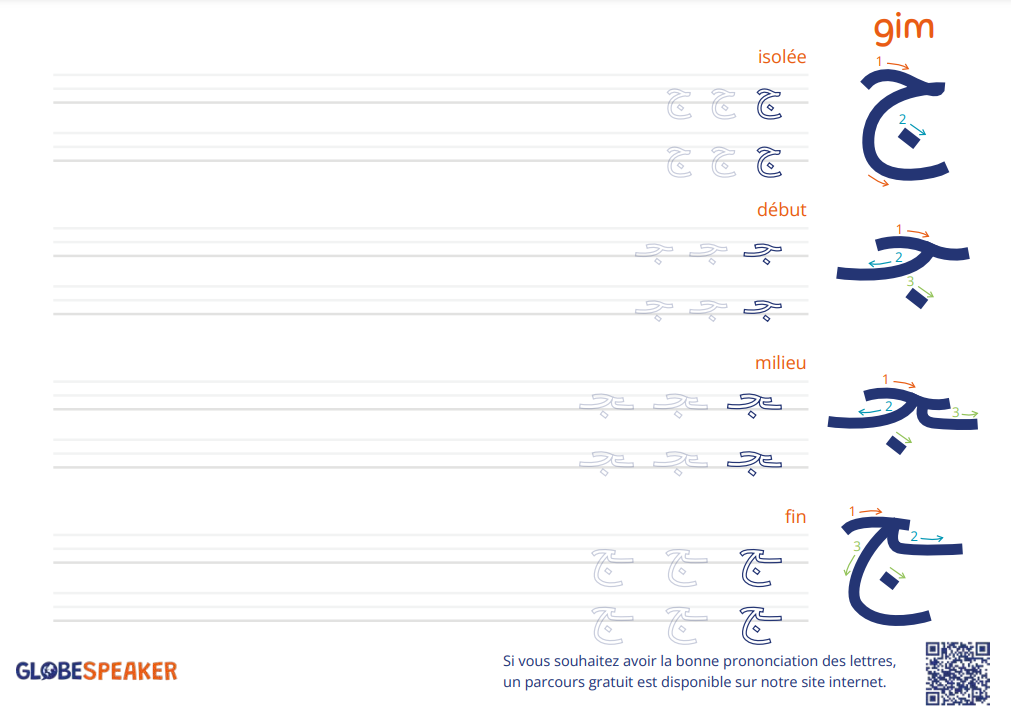
Learning the Arabic alphabet is a fundamental step for any beginner. This alphabet is made up of 28 letters, each of which has a distinct shape according to its position in a word. a word. Arabic writing differs from Latin writing. It is written from right to left, and the letters follow one another fluidly.
Understanding and mastering this alphabet is crucial, as each letter can have up to four different shapes. The main difference with the Latin alphabet is the orientation of the writing and the variation of letters according to context. This first stage of learning paves the way for further exploration of the Arabic language.
DISCOVER THE ARABIC ALPHABET

Reading and writing Arabic
Arabic is read from right to left, which is the opposite of the orientation of Western languages. One of the most distinctive aspects of Arabic reading is the shape of the letters, which varies according to their position in a word: isolated, initial, medial or final. depending on their position in a word: isolated, initial, medial or final. Certain sounds and nuances are not found in Latin languages, requiring special familiarization with Arabic phonetics.
Diacritical marks play a crucial role in providing pronunciation guidance, especially for short vowels, which are often omitted in standard writing. Learning to read and writing Arabic opens the door to a rich literature, from religious texts to contemporary poetry, enriching cultural and linguistic understanding.
LEARN TO READ AND WRITE ARABIC
Time and commitment
How long does it take to master Arabic? The duration depends on your initial level and your objectives. Get a more accurate estimate by assessing your level of Arabic on our platform.


Practical advice
To learn Arabic effectively, immerse yourself in the language by listening to Arabic music or watching Arabic films.
Practise regularly, even if you make mistakes - practice makes perfect.
Utilisez notre application pour améliorer votre vocabulaire et votre grammaire, et participez à des groupes de discussion pour échanger avec d'autres apprenants. N'oubliez pas de vous référer à des livres
specialist books
pour structurer votre étude. Avec persévérance et pratique régulière, vous observerez rapidement des progrès dans votre maîtrise de l'arabe.
Learning Arabic is an enriching journey open to everyone. With the right resources and the right method, you'll soon be able to communicate in this fascinating language.
Globe Speaker to start learning for free
Notre approche innovante est accessible gratuitement pour les débutants. Notre méthode combine jeux interactifs, exercices pratiques et outils de prononciation. Globe Speaker rend l'apprentissage amusant et captivant, idéal pour ceux désireux de s'initier à cette langue captivante sans frais initiaux.



Download the best app for learning Arabic
Put an end to learning at school, get good at foreign languages in just a few weeks with the best app on the French market.


Your questions
on learning Arabic
Can I learn Arabic on my own?

Which countries speak Arabic?
How can I learn Arabic at home?
How do you say hello in Arabic?
What's the best way to learn Arabic?
What kind of Arabic should I learn?
Language Club
The blog that tells you everything about languages



Language Club
The blog that tells you everything about languages
All languages to learn


Certification preparation courses available

Toeic
They learned a new language with Globe Speaker

Very good, fun platform.

Marc • 45 ans
Niveau A2 à B1 - Abonnement Premium
Complète et évolutive.

Louis • 65 ans
Niveau A1 à B1 - Abonnement Premium
Très bonne organisation avec suivi de la formation.

Boumédiane • 29 ans
Niveau A2 à B2 - Abonnement Premium CPF
Plateforme très pédagogique, et adaptée à tous les âges. J'ai vraiment eu l'impression d'apprendre.

Maria • 28 ans
Niveau A1 à B1 - Abonnement Premium
J'ai apprécié de travailler sur la plateforme Globe Speaker, autant de fois que je le voulais ou pouvais, ainsi qu'avec Maria pour la partie coaching.

Véronique • 41 ans
Niveau A2 à B2 - Abonnement Premium CPF
They trusted Globe Speaker






Download our printable materials!
Écriture

Memory
Download successful ✓

Supports imprimables